EV Charge
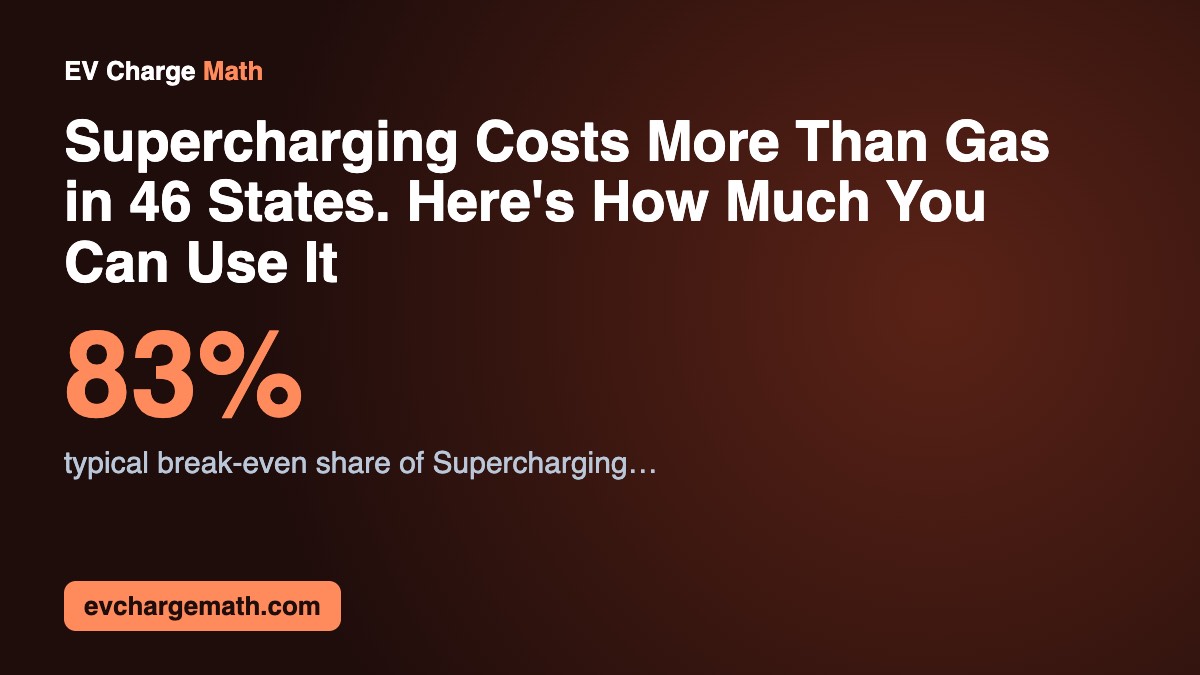
Charging an EV at home is cheaper than gas in every state. Supercharging is a different story. At Tesla’s standard (non-member) prices, a Supercharger costs more per mile than a 30-mpg gas car in 46 of 51 states, from the data we track for each state.
That doesn’t mean EVs lose. Almost nobody charges only at Superchargers. The real question is how much of your charging can happen there before the car stops saving you money. So for every state I worked out that break-even point: the share of your miles you can charge at Superchargers, with the rest at home, and still spend less than on gas.
Where the margin is thinnest
| State | Home, per 1,000 mi | Supercharger, per 1,000 mi | Gas (30 mpg), per 1,000 mi | Max share of Supercharging |
|---|---|---|---|---|
| Hawaii | $130 | $232 | $144 | 14% |
| District of Columbia | $71 | $250 | $144 | 41% |
| Ohio | $53 | $189 | $129 | 56% |
| New Hampshire | $76 | $188 | $144 | 61% |
| New Jersey | $68 | $193 | $144 | 61% |
| Connecticut | $67 | $190 | $144 | 63% |
| Arizona | $41 | $203 | $144 | 64% |
| Georgia | $44 | $175 | $131 | 67% |
| Delaware | $51 | $186 | $144 | 69% |
| Maine | $88 | $169 | $144 | 69% |
| North Carolina | $41 | $169 | $131 | 70% |
| Michigan | $63 | $169 | $138 | 71% |
Hawaii stands out. Home electricity there is already the most expensive in the country, so the gap with gas is small to begin with: $130 per 1,000 miles at home against $144 for gas. Superchargers cost $232. Charge more than about 14% of your miles there and a Model Y costs more to run than a gas car. (The gas figure is the EIA regional average; pump prices on the islands are usually higher, which would push the limit up a little.)
In the District of Columbia the limit is about 41%, and in Ohio about 56%. Ohio is an interesting case because home charging there is cheap ($53 per 1,000 miles), but its Superchargers are among the priciest relative to gas.
Where Superchargers still beat gas
| State | Supercharger, per 1,000 mi | Gas (30 mpg), per 1,000 mi | Difference |
|---|---|---|---|
| Nebraska | $112 | $144 | $32 |
| Washington | $165 | $179 | $14 |
| Missouri | $131 | $144 | $13 |
| Kansas | $138 | $144 | $6 |
| California | $202 | $203 | $1 |
Only 5 states make the list, and in most of them it’s because gas is expensive (California, Washington) or Superchargers are cheap (Nebraska, Missouri), not both. Even there the savings over gas are small compared with charging at home.
How to work out your own break-even
The math is simple. Take what 1,000 miles cost you in gas, subtract what they cost charging at home, and divide by how much more a fast charger costs than home. The result is the share of your miles you can fast-charge before you’re worse off than with gas.
Example for the U.S. average: gas ($144) minus home ($50), divided by Supercharger ($172) minus home. That’s about 78% of your miles.
What this means in practice
- If you can charge at home, you’re fine almost everywhere. Most owners Supercharge only on road trips, a small share of their miles.
- If you can’t charge at home, look at your state’s number. In the states at the top of the table, an EV that lives on fast chargers can cost more to fuel than a gas car.
- Prices drop off-peak and for members. Tesla’s membership and off-peak pricing lower the Supercharger cost, which raises your break-even share. Check the prices at the stations you actually use.
- Efficiency matters more on fast chargers. A thirsty EV pays the high per-kWh price on every mile. See how two EVs compare.
How we calculated this
Home costs use each state’s average residential price from the EIA (August 2026). Supercharger costs use the average standard (non-member) price per kWh at each state’s sites from DCFC Tracker (October 2026). Gas prices are EIA regular gasoline (week of October 12, 2026); for states without their own series, the EIA regional price is used, which is why several states share the same gas cost. All costs use a Tesla Model Y (27.5 kWh per 100 miles, EPA) and a 30-mpg gas car. See the Supercharger cost by state page and our home vs. fast charging guide.
Download the data
Free to use in your story, report or website under CC BY 4.0: just credit EV Charge Math with a link. Updated monthly (August 2026 data).
More EV charging data
- Cheapest states to charge an EV
- Most expensive states to charge an EV
- EV charging cost per month, by state
- EV charging cost per mile by state
- EV vs gas: fuel cost in every state
- Electricity cost per kWh by state
- How much it costs to charge a Tesla
- Tesla Supercharger cost by state
- How long it takes to charge an EV (Tesla and more)
- Level 2 charger installation cost by state
- EV charging cost by state (map)
- EV charging cost calculator
- Cost to charge every EV model
Sources: EIA Electric Power Monthly (August 2026); EIA gasoline prices; DCFC Tracker; fueleconomy.gov.