EV Charge
We may earn a commission if you buy through links on this page, at no extra cost to you. We haven’t tested these chargers ourselves; the numbers come from EPA efficiency, EIA electricity prices and our own cost data.
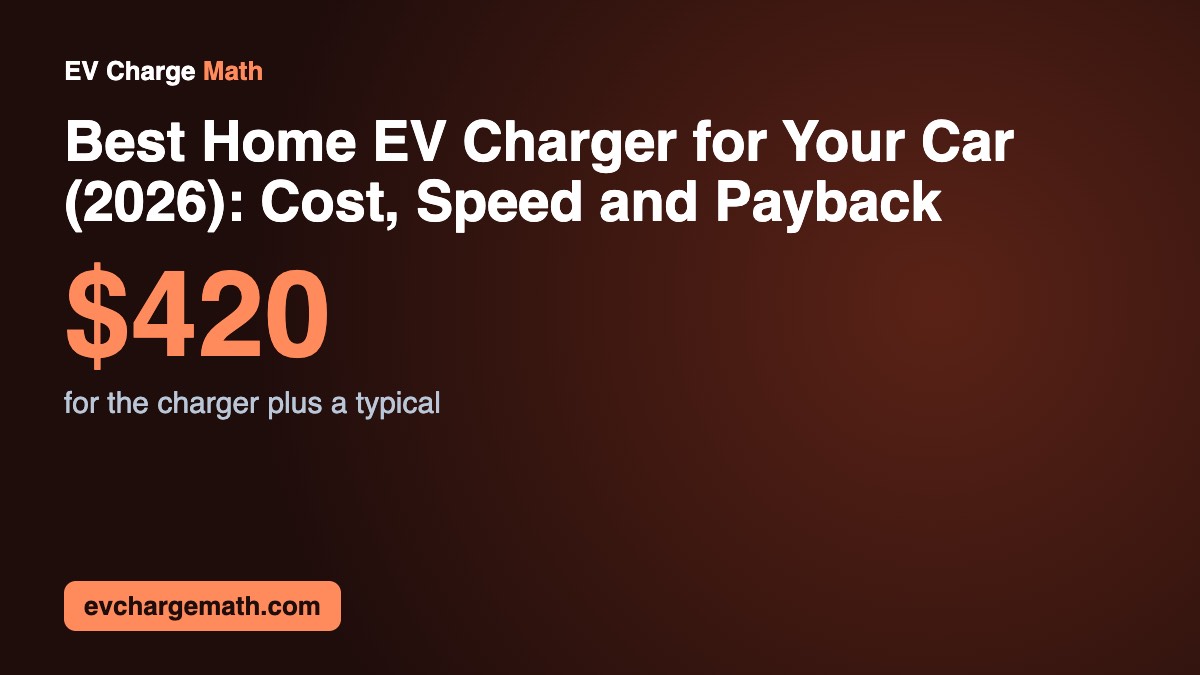
For most EV owners the sweet spot is a 40-amp Level 2 charger on a NEMA 14-50 outlet: about 30 miles of range per hour, a full charge overnight, and a cost of roughly $420 for the charger plus a typical $1,200 if you need a new 240V circuit. Compared with fast charging at about $0.62 per kWh, it usually pays for itself in a few months, or in about a year if you also pay for installation. Below: the options, what they mean for your car, and how fast they pay back.
Quick picks
Prices change; check the current price. Teslas and most 2025-2026 EVs use the NACS port; older non-Tesla EVs use J1772.
Other popular home chargers
These come up in almost every review. We don’t earn anything from them; they’re here so you can compare.
| Charger | Max current | Install | Known for |
|---|---|---|---|
| Tesla Universal Wall Connector | 48 A | Hardwired | Works with NACS and J1772 cars; Tesla app |
| ChargePoint Home Flex | Up to 50 A | Plug-in or hardwired | Adjustable current, scheduling app |
| Emporia Level 2 | Up to 48 A | Plug-in or hardwired | Energy monitoring, low price for a smart charger |
| Grizzl-E Classic | Up to 40 A | Plug-in or hardwired | Rugged outdoor housing, no app |
How fast a home charger pays back, by car
Each row compares charging at home at the U.S. average of 18.16¢ per kWh with fast charging at $0.62 per kWh, for 1,000 miles a month. If you’d mostly charge on a 120V outlet instead, the saving is the same but you give up speed.
| Car | Range per hour (40 A) | Empty to full | Saved per year vs fast charging | Charger pays back | With ~$1,200 install |
|---|---|---|---|---|---|
| Tesla Model Y | 31 mi | 10.5 h | $1,460 | 3 mo | 13 mo |
| Tesla Model 3 | 29 mi | 10.6 h | $1,571 | 3 mo | 12 mo |
| Chevrolet Equinox EV | 26 mi | 11.6 h | $1,732 | 3 mo | 11 mo |
| Hyundai Ioniq 5 | 27 mi | 10.7 h | $1,681 | 3 mo | 12 mo |
| Ford Mustang Mach-E | 26 mi | 9.4 h | $1,786 | 3 mo | 11 mo |
| Kia EV6 | 21 mi | 11.0 h | $2,177 | 2 mo | 9 mo |
| Ford F-150 Lightning | 18 mi | 17.8 h | $2,544 | 2 mo | 8 mo |
| Rivian R1S | 19 mi | 14.9 h | $2,355 | 2 mo | 8 mo |
| Tesla Cybertruck | 20 mi | 16.2 h | $2,278 | 2 mo | 9 mo |
| Nissan Leaf | 29 mi | 10.0 h | $1,593 | 3 mo | 12 mo |
How to choose
Level 1 or Level 2?
A regular 120V outlet adds 3 to 5 miles per hour. That’s enough if you drive under about 30 miles a day and park for 10+ hours. Anything more and you’ll want Level 2 (240V), which adds 20 to 35 miles per hour.
Amps and the circuit you need
A 40 A charger needs a 50 A circuit; a 48 A charger needs a 60 A circuit and must be hardwired. Most homes can take a 40 A charger; if your panel is full, a 32 A charger on a 40 A circuit still refills most EVs overnight.
Plug-in (NEMA 14-50) or hardwired?
Plug-in units go into the same 240V outlet as an electric dryer or range, so they’re easy to take with you when you move. Hardwired units allow 48 A and are often required outdoors. Either way, have a licensed electrician check the circuit.
NACS or J1772?
Teslas and most 2025-2026 models from Ford, GM, Hyundai, Kia, Rivian and others use the Tesla-style NACS port. Older non-Tesla EVs use J1772. Adapters exist both ways, but buying the charger that matches your car is simpler.
What installation costs
A typical job runs about $1,700 including the charger, but the cable run and panel capacity matter far more than the brand. See our Level 2 installation cost by state, and ask your utility about rebates: many offer one for a qualifying charger or for enrolling in an off-peak EV rate.
Pair it with an off-peak rate
The charger is half the saving. Scheduling it to run after 9-11 PM on a time-of-use or EV rate can cut the home cost in half again. Then check your own number in the EV charging cost calculator.
Frequently asked questions
What is the best home EV charger for most people?
A 40-amp Level 2 charger that plugs into a NEMA 14-50 outlet: it adds about 30 miles per hour and costs roughly $420. Pick the NACS or J1772 version to match your car’s port.
Do I need a Level 2 charger?
Not if you drive under about 30 miles a day and can plug in for 10+ hours. Above that, Level 2 is what makes home charging practical.
How much does it cost to install a home EV charger?
About $1,700 on average including the charger, from roughly $1,470 to $2,060 depending on the state, more if your panel needs an upgrade.
Does a home charger pay for itself?
Compared with fast charging at about $0.62 per kWh, a charger usually pays back within months; with a typical installation, in roughly a year for most cars.
Sources: EPA fueleconomy.gov (efficiency and range), EIA Electric Power Monthly (residential prices), DCFC Tracker (Supercharger prices), BLS electrician wages (installation estimate). Charger specs from each manufacturer. How we calculate.