EV Charge
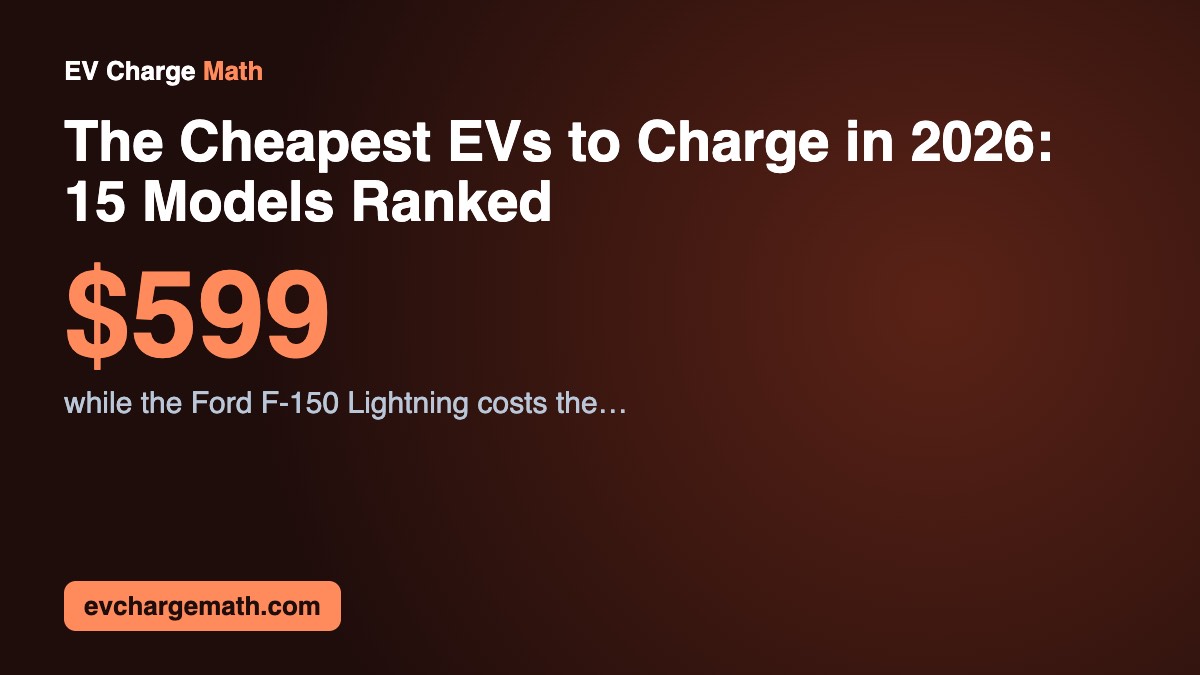
The Tesla Model Y is the cheapest EV to charge annually at $599, while the Ford F-150 Lightning costs the most at $1,044.
15 EVs ranked by yearly charging cost
| # | EV | kWh/100 mi (EPA) | Per mile | Per year at U.S. average |
|---|---|---|---|---|
| 1 | Tesla Model Y | 27.5 | 5.0¢ | $599 |
| 2 | Tesla Model 3 | 29.6 | 5.4¢ | $645 |
| 3 | Volkswagen ID.4 | 29.8 | 5.4¢ | $649 |
| 4 | Nissan Leaf | 30.0 | 5.4¢ | $654 |
| 5 | BMW i4 | 30.8 | 5.6¢ | $672 |
| 6 | Hyundai Ioniq 5 | 31.7 | 5.8¢ | $690 |
| 7 | Chevrolet Equinox EV | 32.6 | 5.9¢ | $711 |
| 8 | Ford Mustang Mach-E | 33.6 | 6.1¢ | $733 |
| 9 | Honda Prologue | 35.3 | 6.4¢ | $769 |
| 10 | Cadillac Lyriq | 36.8 | 6.7¢ | $802 |
| 11 | Kia EV6 | 41.0 | 7.4¢ | $893 |
| 12 | Tesla Cybertruck | 42.9 | 7.8¢ | $935 |
| 13 | Kia EV9 | 43.0 | 7.8¢ | $937 |
| 14 | Rivian R1S | 44.4 | 8.1¢ | $967 |
| 15 | Ford F-150 Lightning | 47.9 | 8.7¢ | $1,044 |
Why the numbers look like this
EV charging costs depend almost entirely on two factors: how efficiently the car uses electricity and what you pay per kilowatt-hour on your local grid. The Tesla Model Y leads because it requires less energy to travel the same distance as heavier or less aerodynamic vehicles. The Ford F-150 Lightning, a full-size electric truck, ranks lowest because trucks are heavier and less efficient by design. Regional electricity rates matter too—states that rely on cheaper fuels or lower-cost generation see lower per-kilowatt-hour prices, which reduces charging bills for any vehicle. Smaller, lighter cars with better aerodynamics consistently cost less to charge than larger vehicles, regardless of brand. These efficiency differences compound over time: a vehicle that wastes energy costs more to operate every single day.
What you can do
- Check your utility bill for your actual electricity rate and recalculate these costs for your region—rates vary significantly across the country.
- Compare the EPA efficiency rating (MPGe) of any EV you’re considering, not just the sticker price. Lower efficiency means higher yearly charging costs.
- If you’re choosing between vehicle sizes, remember that a smaller or lighter EV will cost substantially less to charge over time than a larger one.
- Consider charging during off-peak hours if your utility offers time-of-use rates, which can lower your effective cost per kilowatt-hour.
Frequently asked questions
How much does it cost to charge an EV for a year?
It depends on the vehicle’s efficiency and your local electricity rate. Based on August 2026 data, efficient models like the Tesla Model Y cost $599 per year, while less efficient models can cost over $1,044 annually at the national average rate of 18.16¢ per kilowatt-hour.
Is charging an EV cheaper than gas?
Yes. A 30-mpg gas car costs $1,732 per year to fuel at current prices, while the most efficient EV in this ranking costs $599 per year to charge, saving $1,133 annually on energy costs alone.
Why do some EVs cost more to charge than others?
Efficiency varies based on vehicle weight, aerodynamics, and motor design. Heavier vehicles and trucks require more electricity per mile, raising annual charging costs even if electricity rates stay the same.
Does my electricity rate change these numbers?
Yes, significantly. These rankings use the national average rate of 18.16¢ per kilowatt-hour. If you pay more or less than this rate, your actual charging costs will be higher or lower for every vehicle on this list.
Your bill depends on your own rate and miles. Put them in the EV charging cost calculator, or see every state in the cost by state table and the monthly price index.
Cite or embed this data
Journalists, bloggers and researchers are welcome to use these numbers. Please credit EV Charge Math with a link: EV Charge Math, “The Cheapest EVs to Charge in 2026: 15 Models Ranked”, August 2026 data, https://evchargemath.com/cheapest-evs-to-charge/
More EV charging data
- Cheapest states to charge an EV
- Most expensive states to charge an EV
- EV charging cost per month, by state
- EV charging cost per mile by state
- EV vs gas: fuel cost in every state
- Electricity cost per kWh by state
- How much it costs to charge a Tesla
- Tesla Supercharger cost by state
- How long it takes to charge an EV (Tesla and more)
- Level 2 charger installation cost by state
- EV charging cost by state (map)
- EV charging cost calculator
- Cost to charge every EV model
Sources: EIA Electric Power Monthly, table 5.6.A; EIA gasoline prices; fueleconomy.gov (EPA). Method: how we calculate. Updated October 25, 2026.